Showing posts with label GST. Show all posts

Monday, 2 May 2016

VAT on Restaurant Bill

As per settled law VAT can be imposed on sale of goods only and not on service. Service can be taxed by Service Tax Laws. The authority competent to impose service tax has also assumed competence to declare what is service. If State has not challenged the same, it means state has accepted cum assumed 40% is service part on restaurant bill. Therefore, where element of service has been so declared and brought under the Service Tax vide Government of India notification dated 06.06.2012, (i.e. 40% of bill amount to the customers having food or beverage in the restaurant was made liable to service tax) no Value Added Tax can be imposed thereon.


It is well known and settled fact that restaurant bill includes both component Goods and Service. And since service component is there central government is levying service tax on discounted rate means on 40% value of entire bill considering 40% as a service. If restaurant owners are charging VAT on entire bill means they are charging, collecting and depositing the VAT on service part also then
charging, collecting and depositing the VAT on service part is unconstitutional and against the soul and objective of article 366(29A) of constitution.
Collecting unconstitutionally VAT on service components of restaurant bill is actually unjust enrichment of VAT department and also public of state is paying unnecessary tax from their pocket to make unjust enrich to VAT Department.
Also some restaurant in absence of clarity on law charging service tax on Packed Items having MRP which is incorrect.
It is unconstitutional practice which is against the soul and objective of constitution as well as against the Public Interest.
For better understanding I am reproducing and attaching herewith the constitutional, legal and judicial background on this case.
A. Constitutional Background
Before 46th Amendment of the Constitution, there was lack of clarity on taxation of bundle cases where material and service both involved in one transaction including works contract. In Landmark decision of State of Madras vs Gannan Dunkerley & Co (Madras ) Ltd. (1958)9 STC 353(SC), pertaining to sales tax , Honorable Supreme Court held that a building contract is one entire and indivisible contract ; there is no sale of goods as a separate contract. A series of the judgment of HC & SC followed this case taking the same view.
Thereafter due to effect of this decision and on recommendation of Law Commission and In order to levy tax on such contracts parliament amended the article of constitution.
And as introduced by the 46th Amendment of the Constitution, bundle cases where material and service both involved in one transaction including works contract were now made divisible into contract of supply of goods and supply of labour and services. In this sense due to this amendment and due to legal fiction indivisible contract become divisible.For Clear understanding I am reproducing here the full clause of Article 366 (29A) after amendment.
Article 366..
(29A) “tax on the sale or purchase of goods” includes—
(a) a tax on the transfer, otherwise than in pursuance of a contract, of property in any goods for cash, deferred payment or other valuable consideration;
(b) a tax on the transfer of property in goods (whether as goods or in some other form)  involved in the execution of a works contract;
(c) a tax on the delivery of goods on hire-purchase or any system of payment by installments;
(d) a tax on the transfer of the right to use any goods for any purpose (whether or not for a specified period) for cash, deferred payment or other valuable consideration;
(e) a tax on the supply of goods by any unincorporated association or body of persons to a member thereof for cash, deferred payment or other valuable consideration;
(f) a tax on the supply, by way of or as part of any service or in any other manner whatsoever, of goods, being food or any other article for human consumption or any drink (whether or not intoxicating), where such supply or service, is for cash, deferred payment or other valuable consideration;
and such transfer, delivery or supply of any goods shall be deemed to be a sale of those goods by the person making the transfer, delivery or supply and a purchase of those goods by the person to whom such transfer, delivery or supply is made;
Now by virtue of Article 366( 29A)(b) of the Constitution of India, the entire indivisible transaction is made divisible by legal fiction into one for sale of goods and other for supply of labour and service.
Also you please note that constitution is allowing taxability on the transfer of property in goods, means as referred “tax on the sale or purchase of goods”, it will be on goods and not other part of bill.
Constitution has specified only “tax on the sale or purchase of goods” is on transfer of property in goods. It means “tax on the sale or purchase of goods” on transfer of property of “non goods” is not subject to sales tax like on service price/ service tax.
This amendment exclusively defines that VAT will be only on Goods and not on other part. In case of bundle cases where material and service both involved in one transaction including works contract,  and on Non Goods Part, VAT can not be applied. Accordingly all the state VAT law has to follow provision of Article 366(29A) and any state law, rule, notification and circular should be according to this article. Any state law, rule, notification and circular if against the objective and provision of said article 366(29A), shall be void.
HIGH COURT 
IN THE HIGH COURT OF UTTARAKHAND AT NAINITAL
Commercial Tax Revision No.02 of 2014RULLING
Valley Hotel & Resorts,
Through its partner Shri Arun Goyal),
Khasra No.1011/2,
Central Hope Town,
Selaqui, Chakrata Road,
Dehradun….. …..Revisionist/Applicant.
Versus
The Commissioner,Commercial Tax, Dehradun. .….Respondent
Mr. P.R. Mullick, Advocate for the revisionist.
Ms. Puja Banga, Brief Holder for the State of Uttarakhand/respondent.
Dated: April 10, 2014
Coram: Hon’ble Barin Ghosh, C.J.
Hon’ble V.K. Bist, J.
(Per: V.K. Bist, J.)
The revisionist is a partnership firm, engaged in the business of hotel. It provides boarding and lodging facilities to its customers. It also provides restaurant services. Upto 01.07.2012, the activities of the revisionist were covered under the Uttarakhand Vat Act, 2005 in respect to supply of cooked food in the restaurant. On 06.06.2012, the Government of India,Ministry of Finance (Department of Revenue) issued a notification amending the Service Tax (Determination of Value) Rules, 2006 by introducing Service Tax (Determination of Value) Rules, 2012, by which 40% of billed value to the customer, for supply of food or any other article of human consumption or any drink in restaurant, was made liable to Service Tax. Thereafter, the revisionist  moved an application under Section 57 of the VAT Act, 2005, requesting not to charge VAT on 40% billed amount to the customer, as same has already suffered Service Tax. The said application was rejected by the Commissioner, Commercial Tax, against which appeal was filed before Commercial Tax Tribunal. Same was also dismissed. Aggrieved thereby,the present revision has been filed.
2. We have considered the submission of learned counsel for the parties. Value Added Tax can be imposed on sale of goods and not on service. Service can be taxed by Service Tax Laws. The authority competent to impose service tax has also assumed competence to declare what is service. The State has not challenged the same. Therefore, where element of service has been so declared and brought under the Service Tax vide Government of India notification dated 06.06.2012, (i.e. 40% of bill amount to the customers having food or beverage in the restaurant was made liable to service tax) no Value Added Tax can be imposed thereon.
3. In our view, the Commissioner, Commercial Tax erred in rejecting the application of the revisionist. Thus, the revision is allowed. Judgments of Tribunal as well as of the Commissioner, Commercial Tax are set aside. The Commissioner, Commercial Tax is directed to pass order afresh in the light of above observations.
(V.K. Bist, J.) (Barin Ghosh, C.J.)
10.04.2014
SUPREME COURT RULING
The Supreme Court’s judgment in IMAGIC CREATIVE PVT LTD Vs COMMISSIONER OF COMMERCIAL TAXES, reported in 2008-TIOL-04-SC-VAT, has thrown up several interesting questions of the leviability of VAT on composite and indivisible contracts.
The question that arose before the Apex Court was, whether,sales tax could be levied, in terms of the provisions of the Karnataka Sales Tax Act 1957, on the entire value of a contract involving advertising services including the value of services, in respect of which, service tax is being paid. Here was the case of a service provider, who was using materials / goods in the course of providing the service as part of an indivisible contract and had been paying service tax. The Karnataka Commercial Taxes Department took the view that it was a composite contract of sale, wherein the taxable value of the goods sold being printed booklets got enhanced by the utilization of the soft skills involved in the process and that, sales tax was payable on the entire value of the contract. The Karnataka High Court, in a judgment (2006-TIOL-431-HC-KAR-IT), upheld the levy of sales tax on the entire value of the contract, including the service element. On appeal, the Apex Court has held that in an indivisible contract (involving sale of materials and rendering of services), there was no justification for levy of sales tax on the entire transaction value.
Some of the highly relevant wordings used by the Apex Court are reproduced below:
“A distinction must be borne in mind between an indivisible contract and a composite contract. If in a contract, an element to provide service is contained, the purport and object for which the Constitution had to be amended and clause 29A had to be inserted in Article 366, must be kept in mind”  (Para 25).
The Apex Court further states in Para 28 of its order, as follows:
“28. Payments of service tax as also the VAT are mutually exclusive. Therefore, they should be held to be applicable having regard to the respective parameters of service tax and the sales tax as envisaged in a composite contract as contradistinguished from an indivisible contract. It may consist of different elements providing for attracting different nature of levy. It is, therefore, difficult to hold that in a case of this nature, sales tax would be payable on the value of the entire contract; irrespective of the element of service provided”.
We need to keep in mind, the decision rendered by the Apex Court in the BSNL Case, wherein the Apex Court had held in Para 85 of the judgment that “in a composite contract of service and sale, it is possible for the State to tax sale element provided there is a discernible sale and only to extent relatable to such sale”, which continues to hold good, despite this judgment.
This position is understandable, in the light of the VAT laws of the country, wherein, in the case of levy of VAT on works contracts, a deduction towards labour and like charges are allowed, while computing the taxable turnover. There is a corresponding logic that we have under the service tax law, wherein, the value of the goods and materials sold by the service provider to the recipient of the service, are exempted from the levy of service tax, in terms of Notification No. 12/2003-ST dated 20th June 2003, which is still valid.

Sunday, 24 April 2016

New MVAT Return System Turning Superfast as IPL Inning


(Fictional character): Krishna, From April 2016, Maharashtra Sales Tax Department has introduced new SAP system and brought various changes in VAT returns. Now bill wise details will have to be given for sales and purchase and many more changes are being made. So what is the procedure of filing returns and it’s impact on business?

Krishna (Fictional character): Arjuna, As the April month started, we saw excitement rising for the IPL 20-20. Like Cricket, now in the same way, the sales tax department until a few years ago had a system like Test cricket matches but now the new VAT system is just like the superfast IPL 20-20. In the past the sales tax returns were checked year to year ( slowly like test match), later on returns were checked TIN to TIN number (fast like one day match) and now they would be checked bill to bill (superfast like 20-20 matches). As in 20-20 cricket matches every ball to ball has to be played, same way the details of every bill to bill has to be provided now. For this, in Dealer’s innings i.e. return filling they will have to provide all details of purchase and sales billwise, Tinwise, Codewise and Return wise and for that Dealer should maintain proper and updated books of accounts. In reply, the sales tax department, on basis each return filed and on “Input Tax Credit Report” would automatically allow or disallow the set off return wise. Earlier, this disallowance was done through assessment or CDA notice. Thus superfast compliance is the need of the hour under  the new system.
Arjun:Krishna, in this new return system what are the major conditions that the Dealers should follow?
Krishna:Arjuna, the major conditions the Dealers should know are as follows:
1. Earlier, the Dealers had to fill various forms like 231,232, etc under VAT, CST, J1 & J2 Annexures and submit them separately on the website of Department Of Sales Tax. But now all the forms are covered under one utility only.
2. There are no changes in the FORM type i.e. 231, 232, etc. through which the returns were submitted but J1 and J2 is replaced by Sales and Purchase annexures.
3. This utility consists of purchase and sales annexures. In this we have to fill details of purchase and sales Billwise, TINwise, Codewise and return wise and after validation the selected form will get automatically filled, which we can check later. Then we will have to manually fill some details in the return of Taxrate, Setoff retention, Payments, etc.
4. After uploading this file on the Sales Tax Department website, it will become a Draft Return, if the details in the return is agreed with, then we can submit it.
5. Dealer can find this utility of this return on the www.mahavat.gov.in website. Further Circular 7T of 2016, Step to Step Guide, FAQ on new returns is also published by the sales tax dept.
6. The responsibility of submitting correct and proper return will be solely of Dealers.
7. If the Draft Return is not agreed with, then the Dealer can make required changes or manually fill the required details.
8. Every Dealer will have to fill the purchase and sales annexure. Only the Dealer under composition scheme will not be required to fill the sales annexure.
9. Dealer filing Nil Return will also have to fill the sales and purchase annexure and submit the return.
10. Many dealers don’t show transactions relating to printing and stationery, repairs, staff welfare, etc. in the return. But now it is expected that all the Dealers will show these transaction in this utility.
11. No negative values can be fed either in the return or in the annexure.
12.  Some Dealer like retails traders, restaurants, medical shops, etc. does hundreds of transactions in a single day and does not know the names of the customers, then sales can be mentioned on aggregate basis.
Arjun: Krishna, what will be the effect of this new system on the Dealers?
Krishna: Arjuna, the major effects of this new system on Dealers is as under:
1. Dealer will get set-off as per the purchase annexure submitted by him but if later the department comes to know that there is a difference between the purchases shown by the Dealer in the purchase annexure and the sales shown by the supplier in the sales annexure then the set-off will get automatically disallowed in next return.
2. To avoid this disallowance of set-off, the Dealer can make the required changes or get them done on the basis of “Input Tax Credit Report” before filing next period return.
3. For the purpose sale return transaction, confirmation of the purchaser will be required as aforesaid or in the next return, the same amount of VAT will be reversed.
4. For the purpose of purchase return, the confirmation of seller is not required.
5. In case of CST declaration forms like C-FORM,F-FORM etc will be given on the basis of the return filed only. Thus this new returns will reduce many formalities of application of C-Forms, etc.
6. In the works contract, the benefit of TDS will get credited in his account only when the contractee has filed his WCT return.
Arjun: Krishna, what one should learn from this new system?
Krishna: Arjuna, today life has become fast and technology based. Everyone wants each and everything immediately in their hands. Till now in the tax laws, the VAT returns would be assessed after 2-3 years and later legal proceedings would be carried out. Now after this new change, the major action would be taken soon, by which the tax evasion would be caught early and the transactions will be done with a genuine person. And also from now onwards the Dealer will have to be alert while doing business transactions. For this the Dealer will have to make various changes in his accounting software. As in IPL batsmen has to play Ball to ball to win it, to file correct and complete return, dealer will have to put sales and purchases details in return on Bill to Bill. Thus life of dealers will be now on superfast mode, before filing return all sales and purchase transactions needs to be closed and reconciled. Further whether the introduction of this new system had reach the Dealers, whether they have been trained or not and whether they will be benefited or not, only GOD KNOWS, otherwise it’s also true that only honest taxpayers are punished many a times!!


Friday, 22 April 2016

Interstate-GST-IGST-Inter-State-Transactions

According to Model IGST Law, IGST shall mean the tax levied under the IGST Act on the supply of any goods and / or services in the course of inter-state trade or commerce. IGST Act shall apply to whole of India.
According to the report of the Task Force on GST, 13th Finance Commission (2009), it had recommended that adoption of the IGST Model for implementation with the caveat that a ‘strong IT infrastructure and complete information of the interstate transactions is a precondition and essential prerequisite for considering the IGST model. Without addressing these fundamental concerns of IT
infrastructure and information support systems, the adoption of IGST model which is still at a conceptual stage is far from realistic at this stage in adoption of GST in the course of interstate transaction in goods and GST for the nation’.
Central Government would levy IGST (which would be CGST plus SGST) on all inter-State transactions of taxable goods and services with appropriate provision for consignment or stock transfer of goods and services. The inter-State seller will pay IGST on value addition after adjusting available credit of IGST, CGST, and SGST on his purchases. The Exporting State will transfer to the Centre the credit of SGST used in payment of IGST. The Importing dealer will claim credit of IGST while discharging his output tax liability in his own State. The Centre will transfer to the importing State the credit of IGST used in payment of SGST.
The Empowered Committee has accepted the recommendation for adoption of IGST model for taxation of inter-State transaction of Goods and Services. The scope of IGST Model is that Centre would levy IGST which would be CGST plus SGST on all inter-State transactions of taxable goods and services. The inter-State seller will pay IGST on value addition after adjusting available credit of IGST, CGST, and SGST on his purchases. The Exporting State will transfer to the Centre the credit of SGST used in payment of IGST. The Importing dealer will claim credit of IGST while discharging his output tax liability in his own State. The Centre will transfer to the importing State the credit of IGST used in payment of SGST. The relevant information is also submitted to the Central Agency which will act as a clearing house mechanism, verify the claims and inform the respective governments to transfer the funds.
Revenue from IGST will be apportioned among Union and States by Parliament on basis of recommendation of Goods and Service Tax Council [Proposed Article 269A(2) and Article 270 (1A) of Constitution of India]. The apportionment will be required as input tax credit of IGST can be used for SGST and vice versa. Since IGST will be on ‘supply of goods or services’, IGST will be payable on stock transfers, branch transfers and even when goods are dispatched inter-state job work and return.
The inter-state adjustment will be made by Central Clearing Agency and the Assessee will not be concerned with such adjustment at all. Under IGST, a dealer can establish hub and spoke approach for distribution of his final products. He can maintain depots at few strategic locations in country and from those locations, he can distribute goods to nearby States. This will be very cost effective distribution network for assessee.
Advantages of IGST Model
The major advantages of IGST Model are:
(a) Maintenance of uninterrupted ITC chain on inter-State transactions.
(b) No upfront payment of tax or substantial blockage of funds for the inter-State seller or buyer.
(c) No refund claim in exporting State, as ITC is used up while paying the tax.
(d) Self monitoring model.
(e) Level of computerization is limited to inter-State dealers and Central and State Governments should be able to computerize their processes expeditiously.
(f) As all inter-State dealers will be e-registered and correspondence with them will be by e-mail, the compliance level will improve substantially.
(g) Model can take ‘Business to Business’ as well as ‘Business to Consumer’ transactions into account.
Salient Features Integrated GST
  • On inter-state and cross border transactions
  • Centre would levy and collect IGST in lieu of CGST and
  • To be shared between Centre / States
  • Single IGST rate
  • IGST would be levied on all inter-State transactions of taxable goods and services with appropriate provision for consignment or stock transfer of goods and services.
  • Inter-State dealer will pay IGST after adjusting available, input IGST, CGST and SGST on purchases.
IGST – Illustration
  • Maharashtra seller selling to Karnataka buyer for Rs.1,00,000/-.
  • IGST payable assuming an 8% rate is Rs.8,000/-.
  • 8,000/- can be paid by adjusting
    • Inter-State purchases (IGST) Rs.3,000/-
    • Local purchases (CGST) Rs.1,500/-
    • Local purchases (SGST) Rs.1,500/-
  • Since dealer has used SGST of Maharashtra to the extent of Rs.1,500/-, Centre has to transfer Rs.1,500/- to Maharashtra Government.
  • IGST of Rs.8,000/- is availed as credit by Karnataka buyer.
  • Karnataka dealer sells the goods at Rs.2,00,000/- attracting CGST of say Rs.16,000/- and SGST of Rs.16,000/-.
  • If IGST of Rs.8,000/- is used to pay the SGST then Karnataka Government has to transfer Rs.8,000/- to the Centre.

Monday, 11 April 2016

DELHI VAT Composition Scheme and FAQs

Composition scheme is the scheme to facilitate small dealers (whose turnover in one year does not exceeds Rs.50 Lac) to pay D-VAT at flat rate of 1% without claiming Input Tax Credits in respect of VAT paid on local purchases made from registered dealers.
1.Who Can apply for Composition Scheme?
Any dealer whose interstate Sales does not exceeds Rs.50,00,000 in a financial year.
2. Who cannot apply for Composition Scheme?
Following are  not eligible to opt for Composition Scheme :
  • Dealer procuring goods from outside Delhi
  • Dealer whose turnover exceeds Rs.50,00,000
  • Dealer who fulfil any other conditions as notified by Commissioner
3.What is the rate of DVAT applicable on dealer opted Composition Scheme?
Every dealer who is registered under Composition Scheme of D-VAT Act is required to make payment of VAT at flat rate of 1% without claiming benefit of Input Taxes paid on Purchases made from Registered Dealer.
Please Note that w.e.f 18.03.2016 Small Restaurants, Hotels, Caterers and Sweet Shops can also opt Composition scheme of registration but they are required to pay DVAT at flat rate of 5% without claiming benefit of Input Taxes paid on Purchases made from Registered Dealer.
4. What are the features of Delhi VAT composition scheme of Registration?
  • Dealer cannot compute his Net Tax Liability as per section 11 of DVAT Act.
  • Dealer cannot issue Tax invoices.
  • Dealer cannot claim benefit of Input Taxes paid on purchases made from registered dealers.
  • Dealer is not allowed to collect any tax from Purchasers.
  • If the Turnover of the dealer exceeds Rs.50,00,000 at any time during the Financial Year then the Composition scheme will be automatically converted into Normal Scheme.
  • A dealer who has defaulted to furnish the returns for two consecutive tax periods by the prescribed due dates shall, with effect from the first day of the next tax period, be liable to pay tax under Normal Scheme.
  • Dealer can continue to retain the original copies of all tax invoices and all retail invoices for all his purchases and copies of all retail invoices issued by him in respect of his sales as required under section 48 of the Act.
5. Is it possible to change “From Composition Scheme to Normal Scheme “or “From Normal Scheme to Composition Scheme”?
Yes, Dealer may voluntarily change its scheme both in the beginning as well as during the financial Year.
6. What is the difference between Normal Scheme & Composition Scheme of Registration under DVAT Act?
NORMAL SCHEMECOMPOSITION SCHEME
Rate of Charging VAT1% or 5% or 12.5%1%
VAT is payable on sale of Exempted goodsNoYes
Benefits of Input Tax AvailableYesNo
TaxCan issueCannot Issue
Return FormVery ComplexEasy
AnnexuresRequired to be filed alongwith ReturnNot Required to filed alongwith Return
Restriction on Central SalesNeverYes
7. What is the procedure to get registration under Composition Scheme?
Follow all steps as specified therein:


(For DVAT Registration – Filing – Consultancy Author Can Be Reached At 8285910007 or  on sonuandfirm@gmail.com)

Monday, 28 March 2016

Delhi Budget 2016-VAT, Excise / Stamp Duty & Luxury Tax changes

Deputy Chief Minister of Delhi Manish Sisodiya presented the Annual Budget for 2016-17 in Assembly on 28.03.2016 and  rationalisesd VAT and Other Duties which may result in reduction in prices of readymade garments, shoes, watches and electric and hybrid vehicles. In this Article we have covered Highlights of Changes related to Taxes/ Duties and Extract of his Budget Speech related to Changes in Tax and Duty Structure.
HIGHLIGHTS OF GOVERNMENT OF NCT OF DELHI BUDGET- 2016-17 RELATED TO VALUE ADDED TAX, EXCISE DUTY, STAMP DUTY, LUXURY TAX ETC.
  • Due to transparent, honest, efficient and effective governance, the overall revenue for the fiscal year 2015-16 has grown at an unprecedented rate of 17% as compared to previous
  • Proper care has been taken in formulation of Tax Policy so that the dipstributive character of Delhi is maintained.
  • VAT constitutes nearly 65% of total tax revenue.
  • Multiple entries relating to some items create ambiguity and confusion which leads to harassment of traders. It has been attempted to simplify the taxation by bringing them into one entry.
  • Utmost encouragement to voluntary compliance of tax has been attempted for a strong partnership with trade.
  • VAT rate on battery operated transport means i.e. e-rickshaw, battery operated vehicle and hybrid automobile has been proposed to be reduced from 12.5% to 5%.
  • VAT on Sweets and Namkeens has been proposed to be reduced from 12.5% to 5%.
  • Tax rate on readymade garments costing above Rs.5,000/- has been proposed to be reduced from 12.5% to 5%.
  • VAT on marble is proposed to be reduced from 12.5% to 5%.
  • VAT rate on watches costing above Rs.5,000/- has been proposed to be reduced from 20% to 5%.
  • Rationalization of tax on textiles and fabrics by applying uniform tax of 5% on all varieties of textiles and fabrics (including sarees except khadi and handloom fabrics) has been proposed.
  • Tax on plastic waste has been proposed to be levied @5%.
  • VAT on UPS units has been proposed to be increased to 12.5%.
  • Currently footwears costing above Rs.500/- and school bags costing above Rs.300/- are taxable @12.5%. It is proposed to apply uniform VAT rate of 5% on all kinds of footwear and school bags irrespective of price.
  • By launching of new scheme “Bill Banvao Inaam Pao” powerful impetus has been given to public participation.
  • An award scheme has been launch for “Market Association”
  • In Excise Department, the Inspector Raaj has been done away and point of levy of excise duty has been shifted from transport permit level to import permit level, this has resulted 31% increase in excise revenue collection.
  • Luxuries Tax collection has increased 36.7%, while Entertainment Tax collection increased to 60%. Threshold limit of luxury tax is proposed to be increased from existing Rs.750 to 1500/- per day per room.
  • Introduction of self declaration proposed in luxury tax.
  • Amendments have been proposed in section 17 of Registration Act so as to make compulsory registration of several new instruments.
  • It has been proposed to start online search facility for registered documents shortly. All legacy data since 1985 shall be scanned digitized and readily made available to public.
PART – B of Budget Speech of Delhi Budget 2016-17
115. Hon’ble Speaker Sir, I have dwelt at length upon the policies of the Government in Part-A of my Speech, and once again I state with the highest emphasis at my command that this Government is of, by and for the common man of Delhi. Every penny collected from the people, in the form of taxes and duties, is spent with utmost care and with all honesty and integrity.
116. It is a myth that only the rich pay taxes. The poor, the disadvantaged as consumers of goods and services also pay tax. Thus, while we have to mobilize greater resources to meet the goals outlined earlier we are committed to a tax structure which is just, fair and equitable.
121. Through our transparent, honest, efficient and effective governance, the overall revenue for the fiscal year 2015-16 has grown at an unprecedented rate of 17% compared to the previous year. This was possible through elimination of corruption at the highest levels and significant usage of technology at the levels where the citizens interface with the Government, deploying honest officers in sensitive positions, timely completion of infrastructural projects at reduced costs and reduction of all wasteful expenditure.
Value Added Tax
122. Sir, in the tax revenue, VAT constitutes the major part of our receipts, with nearly 65%- of total collections – and most of our developmental activities depend mainly on the buoyancy and elasticity of tax revenue from VAT. My taxation proposals are founded on the following principles:
123. The first and foremost principle of our taxation policy is to maintain the distributive character of Delhi’s trade.
124. Secondly, it is simplification of the existing system and promotion of an all-round ease of doing business.
125. Thirdly, multiple entries relating to the same item or a common group of items are a great source of ambiguity and confusion, which leads to harassment of traders and create a window for reporting manipulation leading to undesirable behaviour. We have tried to simplify it by bringing them under one entry to the extent possible.
126. Fourthly, our Government is fully committed to reducing tax arbitrage and will attempt to keep a uniform rate with neighbouring states. In several items such as sweets – namkeen, watches, readymade garments, lower tax rate in neighbouring States was causing erosion in the same. We have made efforts to remove such imbalances in our VAT structure.
127. Last and most important principle which is the motive force behind our taxation policy is to encourage voluntary compliance, and forge a strong partnership with the trade and the public.
128. Having regard to the above objectives, I propose modifications in the VAT rate which can be classified into two parts :
  • Reduction in VAT rates
  • Rationalization of tax rates
Reduction in VAT rates
129. Our Government is committed to check rising pollution due to automobiles and to promote use of environment friendly vehicles, VAT rate on battery operated transport means i.e. e-rickshaws, battery operated vehicles and Hybrid Automobiles (i.e. Battery driven with other fuel option), is proposed to be brought down from 12.5% to 5%.
130. Sweets and namkeens are presently taxable @ 12.5%, while the tax rate in Haryana and Uttar Pradesh is 5%. With a view to avoid geographical tax arbitrage, I propose to reduce the VAT on Sweets and namkeens to 5%.
131. At present, readymade garments upto ₹ 5000/- are taxed at 5%, those above ₹ 5000/- are taxed at 12.5%. Again in neighbouring States (U.P. and Haryana) all readymade garments are taxed at 5%. I propose to rationalize the tax rate by taxing all readymade garments @5%.
132. Marble in Delhi is currently taxable at 12.5% being an unspecified item. Marble Trade Association of Delhi has been requesting for lower tax rate to encourage people to buy marble from Delhi Traders only. I understand reducing the tax rate of marble from 12.5% to 5% would be in the interest of revenue and I propose accordingly.
Rationalizing of tax rate
133. Watches in Delhi are taxed differentially at 12.5% (watches upto ₹ 5000/-) and (20% watches above ₹ 5000/-), while they are taxed uniformly at 12.5% in neighbouring states. I propose a uniform VAT rate of 12.5% on all kind of watches.
134. Textile and fabric are presently covered under several entries in the tax rate schedules – some under the exempted list, while others in the taxable category of 5%. I propose to simplify this system by levying a uniform tax rate of 5% on all variety of textiles and fabrics (including sarees) except khadi and handloom fabrics.
135. Plastic waste continue to be exempted whereas plastic raw materials i.e. plastic granules, plastic power and master batches are taxable @5%. Since, plastic waste can also be recycled and used as raw material to make plastic articles, it is proposed to tax plastic waste also @5%.
136. Presently, inverters and UPS are taxable at general un-specified rate of 12.5%. However, there is a duplicate entry i.e. UPS units in Schedule III, which is leading to confusion. Therefore, I propose to omit this entry.
137. Presently, footwear above MRP ₹ 500/- are taxable @12.5%. I propose to rationalize the VAT rate on footwear by subjecting uniform rate of 5% to all footwear irrespective of price.
138. School Bags having MRP upto ₹ 300/- and MRP above ₹ 300/- are taxed at 5% and 12.5% respectively. I propose to rationalize by levying a uniform rate of 5% on all schools bags irrespective of price.
139. In the existing entry of Ferrous and Non-ferrous metals, there is no mention of aluminium or metal sheets, and some items are taxed at higher rate of 12.5%. To remove an ambiguity, I propose to modify the entry as “Ferrous and non-ferrous metals and alloys thereof including their sheets, foils and extrusions. Non-ferrous metals includes aluminium, copper, zinc etc.”
140. Sir, the Tobacco and tobacco products are currently taxable @20%. The relevant entry reads as under :-
“Tobacco and Gutkha, unmanufactured tobacco, bidis and tobacco used in manufacture of bid is and hooka tobacco”.
In order to make it more comprehensive, I propose to modify the entry as under :- “Un-manufactured tobacco, tobacco and tobacco products in all forms such as cigarettes (irrespective of form and length), chewing tobacco, gutkha, cigars, hookah tobacco, khaini, zarda, surti, bidis etc.”
141. In addition to reforms related to the VAT rates, this government has given a powerful impetus to the public participation in tax management by launching a new scheme of ‘Bill Banwao Inaam Pao’. Under this scheme, consumers in Delhi, while making any purchases can send the snapshot of retail bill / invoice to the department through a mobile application. This innovative scheme has promoted a unique partnership between the public and the VAT Department in the context of verification of sale / purchase transactions and compliance, which was based primarily on the visit of tax inspectors in the field only till now. Under the scheme 1% of the entries are shortlisted for award and prize money, thereby incentivizing the participation of consumers. The increasing success of the scheme can be measured from the fact that 8000 entries have been received in the month of February 2016 as against 4000 entries in the month of January 2016 when the scheme was launched.
142. The Government has also introduced a unique Reward scheme to acknowledge and further encourage market and trade associations contributing revenue over and above the targets set for the year. Such associations will get 10% of the revenue generated over and above the target set for the year. Besides this, top 10 performing market association will get cash reward of ₹ 5 lakh each. The award money is to be utilized for the overall improvement of the market and maintenance of public conveniences, beautification, repairs etc.
143. Mr. Speaker Sir, it is evident from the above details that our Government is decisively moving away from the past traditions of command, control and penetration of markets by the interventionist government to the role of an enabler and facilitator.
Excise Duty, Stamp Duty & Luxury Tax
144. Speaker sir, last year in my budget speech I had mentioned about streamlining the liquor trade and eradicating corruption. Today I am happy to inform this august house that the steps undertaken by the Government have started yielding results.
145. You may kindly recall that I had not increased excise duty on liquor last year. However steps were taken to plug loopholes to prevent leakage in excise revenue. We had shifted point of levy of Excise Duty from Transport Permit Level to Import Permit Level. Due to this and other reforms undertaken by the Government, there has been 31% increase in Excise Revenue Collections, from ₹ 3187 crore in 2014-15 to approximately ₹ 4200 crore this year, an all-time high. Inspector raj has been done away with. In the time to come, these existing reforms will not only continue but more such reforms are likely to be introduced.
146. The revenue collection from Luxury Tax has seen an increase of 36.7percent. As against last year’s ₹ 322 crore of revenue from Luxury Tax, this year will exceed ₹ 440 Crore is estimated to be collected.
147. As another step towards a simplified tax regime, I to announce the increase in threshold limit of Luxury Tax from existing ₹ 750 to ₹ 1500. This will reduce tax burden on citizens and tourists and make it easy for small hotels to do business.
148. As on today assessment of all hotels is compulsory. My Government has decided to introduce self declaration in Luxury Tax. Assessment will be done on random basis.
149. The revenue collection from Entertainment Tax has seen an increase of 60 percent. As against last year’s ₹ 148 crore of revenue from Entertainment Tax, this year exceed ₹ 237 Crore is estimated to be collected.
150. Sir, our Government is deeply conscious that tax rates/duties must be in line with economic realities. Given the slowdown in the real estate sector, our government (unlike previous policies) held the circle rates in urban areas stable and did not increase them. I am happy to announce that against stamp duty collection of ₹ 2779 crore up to 31st March, 2015, the stamp duty collection was ₹ 3359 crore up to 22/3/2015 which is 21% higher than last year. In order to keep up the momentum, various new initiatives are being proposed so as to enhance the quantum of stamp duty collection.
151. A separate Stamp Act for Delhi is on the anvil. The Bill aims to simplify provisions, reduce arbitrary power and at the same time increase revenue. Another new initiative has been on-line payment of stamp duty for companies issuing shares and debentures. Efforts are being made to bring more transactions into the net of registration and stamp duty. Amendments have been proposed in Section 17 of Registration Act so as to make compulsory registration of several new instruments.
152. Our Government proposes to start online search facility for registered documents shortly. All legacy data since 1985 shall be scanned, digitized and readily made available to public for search.
153. “I should love to satisfy all, if I possibly can; but in trying to satisfy all, I may be able to satisfy none. I have, therefore, arrived at the conclusion that the best course is to satisfy one’s own conscience and leave the world to form its own judgment, favorable or otherwise.” ― Mahatma Gandhi

Friday, 12 February 2016

Delhi VAT: DVAT Registration Online Process In 2016

Good News for all those who want to trade online on Webportals like Flipkart, Snapdeal or Amazon then you should have a Delhi VAT registration Number (TIN Number) and those who want to start their small medium Businesses.
As The Department of Trade and Taxes has made certain relaxations in its rules of granting Registration like No Surety is required to apply for registration.

You can apply for registration by following these steps.
1.Who can obtain registration
  • Individual (Proprietorship Firm)
  • Person who want to trade online on ecommerce sites like Flipkart,Snapdeal etc.
  • Partnership Firm
  • Private Ltd. Company
  • Public Limited Company
  • Government Company
  • Government Deptt/Society/Club/Trust
  • Hindu Undivided Family
  • PSU
  • Bank
2.How to Obtain Registration
Filing DVAT form online on http://dvat.gov.in/website/home.html
3.Fee charged by Government
  • For DVAT registration : Rs.1,000
  • For DVAT + CST registration : Rs.1,025
4.Penalty if dealer fails to obtain DVAT registration
Where a person who is required to be registered under DVAT Act fails to apply for registration within one month from the day he is required to make application, then he shall be liable to pay penalty equal to Rs.1,000 per day from the date of default subject to the maximum of Rs.1,00,000.
5.Types of Registration Schemes
  • Composition Scheme : Dealer is required to pay DVAT at flat rate of 1% without claim benefit of Input Taxes Paid.
  • Normal Scheme : : Dealer is required to pay DVAT at rates prescribeD i.e. 1%, 5%,12.5 & Dealer can claim benefit of Input Taxes Paid.
6.Documents required for DVAT registration
ProprietorshipPartnership FirmCompany
PAN of ProprietorPAN of FirmPAN of Company
Identity Proof of ProprietorIdentity Proof of all PartnersIdentity Proof of all Directors
Address Proof of ProprietorAddress Proof of all PartnersAddress Proof of all Directors
Address Proof of Place of BusinessAddress Proof of Place of BusinessAddress Proof of Place of Business
Photograph of ProprietorPhotograph of all PartnersPhotograph of all Directors
7.ONLINE DVAT REGISTRATION PROCESS
STEP 1 – First of all visit website of DVAT Department using this URL.
http://dvat.gov.in/website/home.html

Then go to New Registration Segment.
STEP2 – Fill this form very carefully as it is relevant for PAN verification by Department of Trade and Taxes.

Do Consider:
  • Change in name of Firm/Company is not possible until registration certificate is sanctioned.
  • For those who want to apply for TIN on the name of One Person Company.;Select Others in the Constitution of Business Dropdown.
  • If you are requesting registration twice then temporary TIN will not be allotted to dealer.
  • Once you have selected VAT registration, you cannot switch it to VAT+CST registration.
Once you fill this form, you receive an email from DVAT help desk.

STEP 3 – Your PAN verification may took 1 day and after which you will receive two mails from DVAT helpdesk.
First Mail gives you the status of PAN verification.                                                            OR
Second Mail will give you Reference Number and Password.
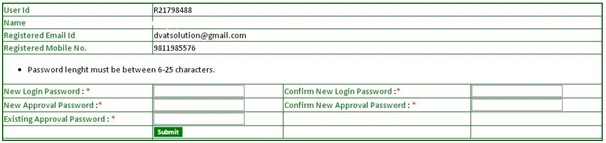
STEP 4 – Again visit site using first URL, go to Dealer login segment and Change Password.

Use Reference no as User ID and Password that you have received in third mail as specified in Step 3.
Now it require you to change your existing password to new password and approval password.
Please Note – Now approval Password is used to change the Profile Password in Future.
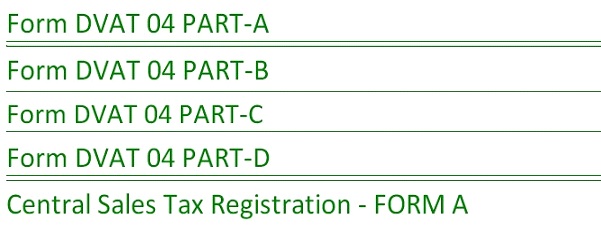
STEP 5 – Start filling registration form
If you have selected VAT registration then you need to Fill only DVAT-04, but
If you have selected VAT+CST registration then you need to Fill DVAT-04 as well as CST-FormA.
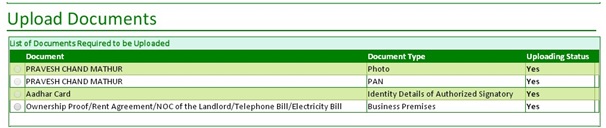
STEP 6 – Upload the scanned requisite documents in PDF Format.

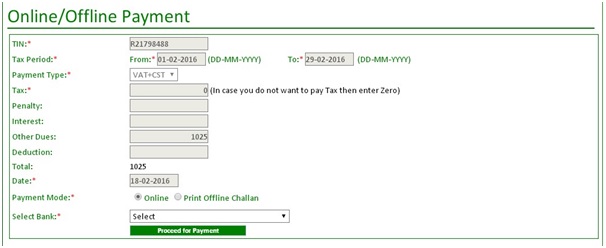
STEP 7 – Now it is the time for you to make payment of Court Fee either through online mode or offline mode.

Here is the updated list of Banks eligible to make DVAT payments.
If you choose to make payment through online mode then you can see your payment record here only but it may take 1-2 days and until it reflect here as paid ,further process is not possible.
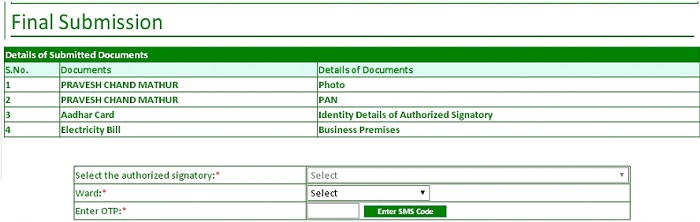
STEP 8 – Go to Approval — Submit section and submit it.

Points that one should consider before starting filling online application.
⇐ Never try to submit forms in multiple attempts as it may block your access.
⇐ If OTP does not come in 5-10 minutes, then never try too many attempts otherwise Server may fail to accept all OTP’s.
⇐ Review form twice before submission, because once form is submitted further changes not possible until verification process completed by VAT Inspector.
⇐ No surety is required to apply for DVAT registration which was required earlier.
⇐ In case dealer already has a TIN allotted with same PAN or he has TIN anytime in past, then Temporary TIN will not be allotted to him immediately.  Rather it will be allotted only after verification by VAT Inspector
⇐ Banquet Halls can apply for registration by filing formBE-2.
⇐ With Effect from 06.2015E Commerce Portals like Flipkart,Snapdeal,Amazon etc are required to get themselves registered under DVAT Act through form EC-1 – [No.F.3(515)/Policy/VAT/2015/330-41].
Once your registration complete its not over, now you need to file DVAT Return on quarterly basis along with all its annexures even if you had not carried any transaction during the said quarter.
Non Filing may attract penalty of Rs.400 per day and Registration Certificate might be cancelled by VAT Officer.
In case annexure 2A & 2B filed by the dealer is mismatched in department’s record then it may results in payment of Penalty of higher of Rs.10,000 or DVAT amount.
Please Note that the Department of Trade and Taxes has recently issued a new annexure 1E on 29.12.2015 which every dealer who trade in goods using E Commerce Portals like Flipkart,Snapdeal etc is required to file at the time of furnishing his DVAT return.
Non Filing may attract penalty of Rs.50,000.
(Author Can Be Reached At 8285910007 or  sonunandfirm@gmail.com)

Thursday, 28 January 2016

How To Rectify DVAT 2A-2B Mismatch

What is form 2A & 2B
Form 2A contain the details of all local purchases made by a registered dealer during the period (quarter) & Form 2B contain the details of local Sales made by a registered dealer during the period (quarter).
Who is required to fill Form 2A & 2B
Every dealer who is registered under DVAT Act ’2004 except Banquet halls & person carrying on E commerce business (say.Flipkart,Snapdeal)
What is the content of Form 2A & Form 2B
Following details are required to be given in Form2A
  1. TIN of Seller/Purchaser
  2. Name of Seller/Purchaser(Autofilled)
  3. Classification of goods (VAT Rate)
  4. Invoice Amount
What is 2A & 2B mismatch.
  • It can better be understand with the help of an illustration
Suppose Mr.A purchase goods from Mr.B
INVOICE
Value =Rs.1000
+VAT =Rs.50
Invoice Value =Rs.1,050
Now,
Mr.A in his form 2A wrongly shows
Purchase value = Rs.1100
   +VAT = Rs.55
   Invoice Value = Rs1155
&
Mr.B in his form 2B correctly shown the sales at
Value =Rs.1000
+VAT =Rs.50
Invoice Value =Rs.1,050
The difference in Vat value (Rs.55-Rs.50) Rs.5 is called as VAT Mismatch
What are the reasons of Mismatch
Following can be the reasons of mismatch
  1. Entered incorrect TIN Number
  2. Entered incorrect amount
  3. Issuance of Retail invoice in place of Tax Invoice
Who receive notice of Mismatch
  • Only Purchaser of Vatable goods receive notice from Department of Trade & Taxes
  • Since ,It is the responsibility of the purchaser to provide correct information to the department as he is willing to claim Input Tax Credit against output VAT liability.
  • If purchaser provide incorrect information at higher value then it will create additional VAT Liability to him only which is beneficial to Department.
  • Practically , No notice is received nowadays , directly demand order received in Form 24 Specifying the amount of VAT & Interest and Form 24A specifying the amount of penalty
At what rate Interest would become payable by the dealer
  • If the dealer fails to pay VAT demand within the time as may be specified in the demand order, then he shall be liable to pay Interest in addition to VAT payable at the rate of 1.25%per month of part of month.
Is it possible to waive off Interest in an appeal or otherwise
  • No , Not at all
What is the amount of penalty that can be levied by VAT officer in respect of mismatch report
  • Amount of penalty that can be levied on Dealer: Rs.10,000 or VAT demand whichever is higher.(Without Limit)
Is it possible to waive of Penalty
  • Yes, It is possible to waive off penalty through an appeal made to Appellate Authority with 30 days from the date of order.
  • If the dealer is aggrieved with the order passed by Appellate Authority then he can file second appeal to Sales Tax Appellate Tribunal
How to remove 2A-2B Demand & Penalty
  • If the mismatch arise due to mistake in DVAT return then it can easily be rectified by revising the return either by Seller or by Purchaser, if the revise period is still available
  • Payment of VAT as demanded in Form 24 (Demand order)
  • Filing an appeal to Appellate Authority

(For DVAT Registration – Filing – Consultancy Author Can Be Reached At 8285910007 or  on sonuandfirm@gmail.com)

Popular Posts